Track Order

Psychological Vaccination‏

Vaccinating The Children from the Psychological injuries of the Civil war

I have recently visited my birth place Mogadishu after migrating with my family to London at the age of two.  Visiting where my parents used to say “Mogadishu is where your umbilical cord is buried” was a life changing journey.  The words of my parents “Xundhurtaadaa ku duugan, Xaqeeda ayaa lagaa rabaa” led me to realise the personal and collective responsibility to participate in rebuilding one’s country.  As I studied health and child care with four year practical experience in London, during my visit I focused on looking at ways to help improve the existing schools in Hamar Weyne and Boondheere.  One of the things, I observed in Mogadishu is that it is saturated with NGOs offering a lot of services such as food, vaccination and education.  Majority of these local and international NGOs put more emphasis on meeting the physical needs such as vaccination for tropical diseases, food etc. However, you will hardly see an organisation that vaccinates the children from the psychological diseases of the war.  This is not as tangible as providing food and medicine and the intangible services are difficult to sell to donors.

People sustain psychological injuries even more often than we do physical ones and they can deteriorate if we ignore them.  This is an important area that individual Somalis such as parents, teachers and institutions such as schools, Madrasas, NGOs and the all Media need to positively contribute to short circuit the cycle of violence from this beautiful country.  We need to immunise our innocent children from the unhealthy psychological habits and the negativity surrounding the environment they live in. The educators at home the parents and school (teachers) and the community need to beware of what they are saying in front of their children or students.  Children are born with fitrah clean heart free from negativity and their opinions are influenced by what the people around them think, do and say.  The key problem starts when these groups pass the heritage of enmities arising from historical traumatic events.  This perpetuates stereotypes from one generation to the next, entrenching the conflict for many years to come and the hostile relationship gets integrated into our society.

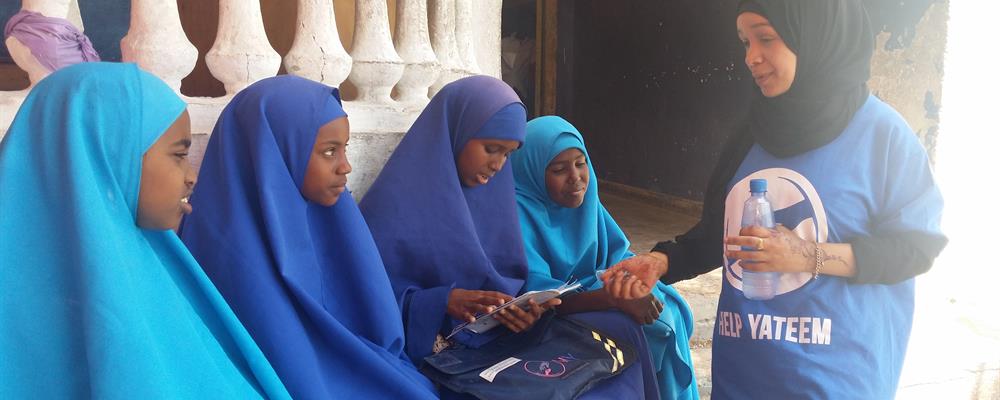
One of the schools, I visited include Banadir Orphan and Needy School in Mogadishu in which the charity “Help Yateem” founders includes my uncle partly supports the school.  I have explained the school staff about my thoughts and they acknowledged the need for addressing the psychological needs of the children.  For example, an orphan whose father was killed by a gun attack may still have that anger and rage in him or her.   Ruminating about upsetting events in this way can easily become a habit, and it’s a very costly one. Therefore, we need to find ways that allows the child to use their anger constructively and failing to do that will lead the children use their anger destructively.  Nobody knows, but there are higher possibilities that those children that are sniffing glues was as a result of chewing over or ruminating about upsetting and negative events occurred in their childhood.
We urge all Somalis abroad and home to put more efforts on reversing the negative psychological behaviors that is integrated into our society.  Let us offer our children psychological first-aid lessons so that they become the true leaders Somalis are yearning for.  We can do this by re-evaluating our conducts in the three most important institutions where children are nurtured such as home, schools and the Masaajid/Madrasah.

Home

One of the best gifts you can give to a child is to assure him/her that you love his/her mother or father.  Traditionally, Somalis are reluctant to show their love for their partner and seen as a weakness.  The prophet SCW said putting food into the mouth of your partner is counted as a charity (Sadaqah).  For a child to see his father putting food into his mother’s mouth is the best gift he could get.  This will have more long lasting effect then buying the latest gadgets.  But, few Somalis have ever tried this, but those who tried were shocked to see the child’s reaction of joy.
Another example, when our child fights with a friend or a neighbour’s child and gets hurt, some mothers tell, you will not come back until you take revenge and hurt him/her the same. This is where our problem lies, we yearn for a good leader, but we fail to nurture that leader.  We should not be blaming our parliamentarian, but our failure to make our homes an environment where kids grow positively and learn how to compromise at early ages.

Masaajid/Madrasah

The Masaajid and Islamic Madrasah play important role in teaching the children the Quran and Hadith.  But one of their shortcomings is that they put too much focus on memorising the Quran and Hadith.  I have visited a well organised Madrasah in Boondheere and most of the kids memorised the 40 hadith of Imam Nawawi and that is a great achievement.
The missing part however was teaching the kids the applications and understanding of the wisdom behind a particular hadith. Another problem might be the Moalim is not practicing what he/she is preaching (Lack of role model) and this will impact the children internalising the behavior prescribed in the hadith and the wisdom behind it.   Teaching Social values known as (Mu’aasharah) dealing with other fellow beings as well as other creations is very important.

Schools

We need an educational system that prepares our children for life and not for work only.   The problem with educating them for work only is when they grow, they will feel as if they are existing only, not living.  We need to introduce activities that encourage role-playing and empathy help children to develop awareness and empathy as well as developing resilience and assertiveness.
Also to educate our children about the consequence of the civil war, the educational system (teachers, schools, textbooks) needs to try to paint a fair, accurate and unprejudiced picture of the conflict. Through stories, discussions, and exercises, teachers can help students (of all ages and levels) understand the complexity of the conflicts that surround them, and develop appropriate responses to the current conflicts in their homes, communities and nation.

Above all, Somalia has been put through a lot of fire similar to the diamond making process.  The diamond starts from coal and through more fire pressure and cutting it shines.  Change does not happen overnight and it is not an easy process.  But if we take the steps to change ourselves for the better, one day Somalia will shine and will lit the light of the Dark Continent (Africa).

Maryam Mohamed
Email details:  maryam@helpyateem.org

Mariam is a member of Help Yateem Charity in London.  Please also remember to help those unfortunate children in Somalia with whatever you can offer such as your knowledge, labour and donation.

Our human survival depends on helping one another

Psychologists argue that the only way one feels a sense of fulfilment is by doing something for someone else, expecting nothing in return (For the sake of Allah). That is why Allah has linked the feeling of completion with helping others. Our very own human survival depends on serving one another and once practiced, trust emerges and our progress continues. A man once asked the Messenger of Allah (S.A.W.): “What kind of person does Allah love most?” He replied: “The person who is most useful to others.”

Today many countries are experiencing a surge in their orphanage population, as a result of recent wars, epidemic diseases and natural disasters. The most excruciating experience for a child is to lose both parents, leaving them on their own, or in the hands of poorly aged grandparents and relatives. Below is a photo of the first Somali girl (an orphan) who became a shoe polisher, in an effort to assist her brothers and sisters.  When many of us see such photos, we acknowledge the problem and show sympathy (we feel for you) without any action, but what is required is empathy (we feel with you) which leads to an act of support.

The issue is that many of us are complacent. Even those amongst us, who are concerned about the affairs of Muslims, often do very little to help. We are often seen seated in our spacious rooms, surrounded by luxury, enjoying the food extravagantly laid out before us.  In this scene, the topic of the conversation is ‘brothers, people are suffering everywhere around the globe, so what is the solution?’  Mere discussions about what can be done will never solve the problem. The quality of the lives of those suffering, our Muslim brothers and sisters, will be determined by the actions of us.

There are varieties of ways in which we can help ease the suffering of the orphans and widows, including:

  • If there are any orphans and widows that are closed relatives, you can directly support them financially and emotionally.  If they live in another country, you can remit what you can afford to them on a monthly basis.
  • You can donate to Help Yateem charity that supports orphans and widows. With your donation you will be helping widows and orphans to become self-reliant in the future. Donate whatever you can afford or pledge a monthly payment.
  • You can volunteer to work for charities like Help Yateem for fundraising campaign and create awareness of the subject.
  • You can work for Orphan charities abroad during your one year university work placement.  Some students do work for charities abroad during the holiday period.  It will be both beneficial for you and the charity you work for, as you gain complimentary social skills whilst giving your services to the charity.

Finally, it is important to note that one can easily benefit himself by lifting others and this is what real leadership is all about. During the moments you support others and help make positive impacts on their lives, you lead. Most of us wrongly view leadership as something beyond us or something, but helping others is all it takes.No one rejects, dislikes, or avoids pleasure itself, because it is pleasure, but because those who do not know how to pursue pleasure rationally encounter consequences that are extremely painful. Nor again is there anyone who loves or pursues or desires to obtain pain of itself, because it is pain, but because occasionally circumstances occur in which toil and pain can procure him some great pleasure.

Be Like a Merciful Father to Orphans

“The best house among the Muslims is one where an orphan is well treated, and the worst house among the Muslims is one where an orphan is badly treated.”

According to the Holy Traditions the best Muslim’s home is the one wherein an orphan is supported and is treated in a loving and affectionate manner, and the worst is that home wherein an orphan lives and is treated badly or cruelly. This is according to the following hadiths:

  • Abu Hurairah (RA) reported Allah’s Messenger (SAW) as saying, “The best house among the Muslims is one where an orphan is well treated, and the worst house among the Muslims is one where an orphan is badly treated.”
  • Abu Hurairah (RA) reports that the Messenger of Allah (SAW) stated”Whoever caresses the head of an orphan (in affection), solely for the sake of Allah, a good deed will be written to his account for every hair over which he passed his hand, and whoever treated an orphan (boy or girl) with goodness and kindness, he and I will be close to each-other in Heaven as these two fingers” The Prophet (SAW) made a gesture with his fingers as explained above.
  1. Abu Hurairah (RA) reported Allah’s Messenger (SAW) as saying, “He who strives to serve a widow and a poor person is like the one who strives in Allah’s way.” He also reported that when a man complained to the Messenger of Allah of being hardhearted he said, “Show affection to the orphans and feed the poor.”
  2. The Story of Halima Sa’ddiyah

In the year in which Prophet Muhammad (SAW) was born, the Bedouin clan of Sa’d arrived in Makkah. Among their women was Halima, who was accompanied by her husband and baby son. They had always suffered great poverty, but this year had been particularly difficult because of famine. The donkey that carried her to Makkah was so weak from hunger that it often stumbled. Halima’s baby cried all the time because she could not feed him properly, and their old she-camel failed to produce milk.

All the women of the clan of Sa’d found a child to take back with them, but not Halima. There was one baby left in Makkah, the orphaned Prophet Muhammad (SAW). As it was customary for the baby’s father to pay the wet-nurses, none of the women would take the orphan. Halimah said to her husband, “I don’t like that I should be the only woman of our clan to return without a baby, I want to take that orphan”. Her husband agreed, adding, “Perhaps it will be that Allah will bless us because of him.”

She said, “When I went to get him he was wearing a woolen dress, whiter than milk. A fragrance of musk spread from him. He lay on his back in sleep, underneath him a piece of green silk. I did not like to wake him because of his beauty and grace, but I came close to him and put my hand on his chest. He smiled and opened his eyes. I kissed him between his eyes and put him to my right breast which gave him all the milk he wanted. Then I placed him on the left, but he refused. That was the way he always was. After he was satisfied, I gave my son his fill. As soon as I brought him to my camp, both my breasts began pouring milk hausarbeit schreiben lassen. By Allah’s grace, Prophet Muhammad (SAW) drank until he was satisfied , as did his brother. My husband went to our old camel for milk, and lo, it was full. He milked enough for both of us to drink our fill and we had a wonderful night. Later my husband said, “Oh Halima, it looks like you have picked a blessed soul ghostwriter hausarbeit kosten. We spent the first night in blessings and bounties, and Allah continues to give us more and more ever since we chose him.” (SAW).

  1. “Would you like that your heart becomes soft and that you acquire what you need schlafdecke baumwolle? Be merciful with the Orphans, pat his head and feed him from what you eat.” [At-Tabaraanee & As-Silsilah as-Saheehah]
  2. Abu Hurraira (RA) reported that the apostle of Allah (SAW) as saying : When a person dies, his/her actions discontinues was ist schurwolle, except for three things that will benefit the deceased in the grave and the hereafter namely:
  1. Sadaqa Jaariya (which is used to benefit Islam perpetually)
  2. The establishment of an institution for knowledge or by which benefit I acquired (such as schools, masjid, orphanages etc hausarbeit kaufen.)
  3. A pious child who prays for the deceased.
Back to Top
Product has been added to your cart
Compare (0)